Showing posts with label Germany. Show all posts

Guido Westerwelle, German Vice Chancellor

27 December 1961


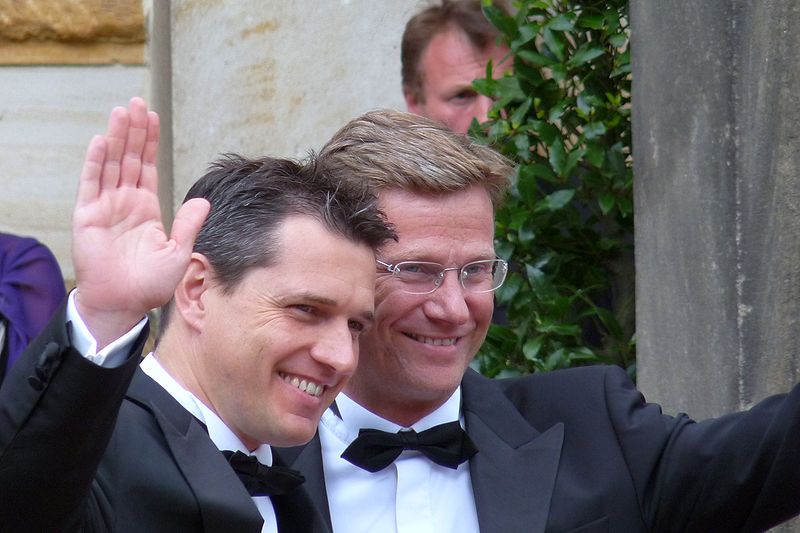
Guido_Westerwelle (right)  and partner Michael Mronz  (L)

Guido Westerwelle is a German liberal politician, currently serving as the Foreign Minister and Vice Chancellor of Germany in the second cabinet of Chancellor Angela Merkel (since 28 October 2009). He is the first openly gay person to hold either of those positions. Since 2001, he has been the chairman of the Free Democratic Party of Germany. A lawyer by profession, he has been a Member of Parliament since 1996.

Westerwelle joined the FDP in 1980. He was a founding member of the Junge Liberale, the youth organization of that party, and was its chairman from 1983 to 1988.

Having been a member of the Executive Board of the FDP since 1988, he first gained national prominence in 1994, when he was appointed Secretary General of the party. As such, he was a notable proponent of an unlimited free market economy and took a leading part in the drafting of a new party programme.
In 1996, Westerwelle was first elected a member of the German Bundestag, filling in for Heinz Lanfermann, who had resigned from his seat after entering the Ministry of Justice. In 1998, Westerwelle was re-elected to parliament.
In 2001, he succeeded Wolfgang Gerhardt as party chairman, who however remained chairman of the FDP's parliamentary group. Westerwelle was then the youngest chairman in the party's history,
Until 2004 he was not openly gay, although this was fairly common knowledge in the general public. On 20 July 2004, Westerwelle attended Angela Merkel's 50th birthday party accompanied by his partner, businessman Michael Mronz, thereby tacitly acknowledging that he was gay. It was the first time that he attended an official event with his partner. Today, he is frank about his homosexuality and lives together with his partner Michael Mronz. The couple registered their partnership on 17 September 2010 in a private ceremony in Bonn


Enhanced by Zemanta

27 December: Guido Westerwelle, German Vice-Chancellor

27 December 1961


Guido_Westerwelle (right)  and partner Michael Mronz  (L)

Guido Westerwelle is a German liberal politician, currently serving as the Foreign Minister and Vice Chancellor of Germany in the second cabinet of Chancellor Angela Merkel (since 28 October 2009). He is the first openly gay person to hold either of those positions. Since 2001, he has been the chairman of the Free Democratic Party of Germany. A lawyer by profession, he has been a Member of Parliament since 1996.

Westerwelle joined the FDP in 1980. He was a founding member of the Junge Liberale, the youth organization of that party, and was its chairman from 1983 to 1988.

Having been a member of the Executive Board of the FDP since 1988, he first gained national prominence in 1994, when he was appointed Secretary General of the party. As such, he was a notable proponent of an unlimited free market economy and took a leading part in the drafting of a new party programme.
In 1996, Westerwelle was first elected a member of the German Bundestag, filling in for Heinz Lanfermann, who had resigned from his seat after entering the Ministry of Justice. In 1998, Westerwelle was re-elected to parliament.
In 2001, he succeeded Wolfgang Gerhardt as party chairman, who however remained chairman of the FDP's parliamentary group. Westerwelle was then the youngest chairman in the party's history,
Until 2004 he was not openly gay, although this was fairly common knowledge in the general public. On 20 July 2004, Westerwelle attended Angela Merkel's 50th birthday party accompanied by his partner, businessman Michael Mronz, thereby tacitly acknowledging that he was gay. It was the first time that he attended an official event with his partner. Today, he is frank about his homosexuality and lives together with his partner Michael Mronz. The couple registered their partnership on 17 September 2010 in a private ceremony in Bonn


Enhanced by Zemanta

Guido Westerwelle, German Vice-Chancellor

27 December 1961


Guido_Westerwelle (right)  and partner Michael Mronz  (L)

Guido Westerwelle is a German liberal politician, currently serving as the Foreign Minister and Vice Chancellor of Germany in the second cabinet of Chancellor Angela Merkel (since 28 October 2009). He is the first openly gay person to hold either of those positions. Since 2001, he has been the chairman of the Free Democratic Party of Germany. A lawyer by profession, he has been a Member of Parliament since 1996.

Westerwelle joined the FDP in 1980. He was a founding member of the Junge Liberale, the youth organization of that party, and was its chairman from 1983 to 1988.

Having been a member of the Executive Board of the FDP since 1988, he first gained national prominence in 1994, when he was appointed Secretary General of the party. As such, he was a notable proponent of an unlimited free market economy and took a leading part in the drafting of a new party programme.
In 1996, Westerwelle was first elected a member of the German Bundestag, filling in for Heinz Lanfermann, who had resigned from his seat after entering the Ministry of Justice. In 1998, Westerwelle was re-elected to parliament.
In 2001, he succeeded Wolfgang Gerhardt as party chairman, who however remained chairman of the FDP's parliamentary group. Westerwelle was then the youngest chairman in the party's history,
Until 2004 he was not openly gay, although this was fairly common knowledge in the general public. On 20 July 2004, Westerwelle attended Angela Merkel's 50th birthday party accompanied by his partner, businessman Michael Mronz, thereby tacitly acknowledging that he was gay. It was the first time that he attended an official event with his partner. Today, he is frank about his homosexuality and lives together with his partner Michael Mronz. The couple registered their partnership on 17 September 2010 in a private ceremony in Bonn


Enhanced by Zemanta

The Berlin Wall Falls-20th Anniversary

For much of my life, the Berlin Wall was part of the world I grew up in.

It was created on August 13, 1961, eight months before I was born. It was strengthened and improved over several decades and symbolized not only the dividing line between West and East Berlin, but between communism and democracy.

It cost 136 East Germans their lives trying to cross it to freedom in West Berlin and billions for the East German government to maintain it and a similar barrier between the two Germanys.

It even became part of my own lexicon. If I had a 'no way in Hades' intention of doing something, I'd say, "That'll happen when the Berlin Wall comes down."

On November 9, 1989 it did.

The pump had been primed by demonstrations in Leipzig, East Germany that summer. They were allowed to happen despite a massive police and military presence. Remember the East Germans were the first to congratulate the Chinese government after the violent suppression of the June 4 Tienanmen Square demonstrations in Beijing.

Those demonstrations were fueled by Hungary and Czechoslovakia's August decision to open their border with Austria and allowing East German citizens on vacation there to leave their countries for the West.

At a routine late afternoon news conference, East German Politburo member Gunter Schabowski casually declared that East Germans would be free to travel to the West immediately.

The decision had already been made, but Schabowski got the date it was going to start crossed up. He tried to clarify his comments and said the new rules would take hold at midnight, but events moved faster as the word spread.

Thousands of East Germans surged toward the Wall checkpoints, including future German chancellor Angela Merkel, overwhelming the border guards. With no orders from the top forthcoming, they opened the gates and kicked off the biggest celebration in history.

The Wall fell, and months later East Germany ceased to exist as well.

Hard to believe twenty years have passed since then.

Angela Merkel Reelected German Chancellor

While we were sleeping on this side of the Pond, the Germans were headed to the polls today. The results were the opposite of what happened in the States and Japan.

German voters reelected their popular chancellor Angela Merkel to a second term.

While Merkel's Christian Democratic Union party CDU/CSU lost some support from the 35.2% they garnered in 2005 to 33%, another coalition partner, the pro-business Free Democrats (FDU) share of the German electorate rose from 9.8% to 14.5%

That means the center-right coalition she put together has a narrow majority over the Social Democratic Party (SPD) and the two other major leftist parties which increased their share of the vote. The Greens picked up 12% white the Left grabbed 10% of the German electorate

"My understanding was, and my understanding is, that I want to be the chancellor of all Germans," Merkel told supporters, adding that protecting and creating jobs "will be my highest aim."

This election was also occurring at a critical time for Europe's largest economy, which is like everywhere else on the planet recovering from its deepest recession of the post-war era.

The resulting center-right government she's forming will allow her to pursue more conservative policies such as extending the life of German nuclear plants and renewing the increasingly controversial deployment of German troops to Afghanistan.

The last time a center right government led Germany was when Helmut Kohl was chancellor from 1982-1998.

Her challenger in the vote was Social Democrat (SPD) Frank-Walter Steinmeier. He appeared on television shortly after the first projections came out and conceded that his party had suffered a "bitter defeat", garnering only 22.5% support.

Merkel has ruled for the past four years in a "grand coalition" with the SPD but can now end that partnership and work with the FDP. She has stated that it's a grouping better placed to help nurture Europe's largest economy back to health.

We'll see in four years if Chancellor Merkel is right.

Blog Archive