Showing posts with label Martin Scorsese. Show all posts

Shine a Light...Scorsese doc illuminates surface but falls short!


"Shine a Light" igniting the silver screen in IMAX is a visual experience you may not want to miss - if you're a Rolling Stones fan - in particular.

In the fast-paced documentary, with Oscar-winning Director Martin Scorsese at the helm, a penetrating lens slices through layers of the mystique with razor-sharp precision close to the bone.

But, ultimately, the doc misses its mark.

By the end of the film, Jagger remains as elusive and mysterious as ever.

But don't say Scorsese didn't try.

In an insightful effort to add a bit of depth and breadth to mix, Scorsese handily juxtaposed old news clips, with scintillating stage footage, to great effect.

After all, the mesmerizing image of Jagger - prancing, pouting and sashaying about - is still potent stuff.

By today's standards, though, Jagger pales a tad.

Indeed, a younger generation in a feeding frenzy over titillating sensual MTV images ( and used to slick choreographed numbers by boy-bands and the like) may find Jagger a bit tame.

But, the pop icon still awes.

In what amounts to a tribally-inspired sexually-charged strut - a bold-faced tease, if you like - Jagger still manages to captivate and hold the excited crowd in his thrall.

Years ago, when the celebrated Pop Icon was queried about the phenomenon of his success, Jagger (then, a doey-eyed innocent - on the surface at least - who sported a page-boy cut and fashionable tweed jacket with collar turned up, just so) opined off the cuff:

"I guess, there is a chemical reaction, of sorts."

News reels of yesteryear reveal a surprisingly down-to-earth quality and Jagger's healthy sense of humor.

For example, when Dick Cavett starts to pose a simple question - which ends up being a long-winded, confusing one - Jagger grins, shakes his head, and confesses with a sheepish look on his face.

"I've forgotten the question."

Keith Richards could be remarkably quick on the uptake, too.

When one reporter probed - What question are you asked most?" - without skipping a beat e chuckled "That one" - with a delicious smile on his face.

Given the opportunity, I'd ask Mick about his wardrobe selections.

Are they of his own choosing - conjured up with the assistance of a stylist - I wonder?

In "Shine", he sparkled and made tantalizing fashion statements.

The lead singer for the Stones - the world's "top rock band? - tends to favor elegant button down shirts in lush fabrics (oftentimes, fashioned in blood red) usually highlighted with a stylish panels adorned with sequins running down the front.

On occasion, he squeezed into a black "T" with a spray of glitter across the face - which caught the light - and subsequently dazzled.

In one shot, he looked for all-the-world like an idyllic "Prince of Pop" in a tastefully-tailored Tuxedo jacket - with ubiquitous tails and satin lapels - to boot.

A mainstay?

Black jeans, which fit snugly, and screamed out pure "sex" appeal.

At the beginning of the film, Scorsese often came across as a wise old owl perched on high from afar.

His on-the-ball crew often captured the award-winning director fussing about behind-the-scenes - and occasionally - rabble-rousing with Jagger over an issue or two.

But - when the lights went up and the show began - the camera-work was flawless and carried out to perfection.

The expert cameraman were there to catch each solo riff, or striking vocal that chimed in unexpectedly from across the stage, for instance.

In fact, the reveal was so up-close and personal now and then, that the audience caught sight of Jagger's dental work and perspiration soiling his underarms.

Back off a little, Marty.

While the cinematography was excellent for the most part, the lighting - in contrast - was not very flattering to the boys, at all.

If what they say is true - you get the face you deserve at fifty - then it applies in this instant case.

The mugs of Mick and the boys were haggard and deeply-lined; a roadmap which reflected the downside of their jet-setting, party-hearty lifestyle, eh?

One failing of the documentary?

Scorsese failed to take a foray into their backstage personas; in fact, their seemingly endless days of wine and roses and lusty pursuit of women, is left out in the cold.

Essentially, the doc is a superficial glance at Jagger and the lads.

In sum, "Shine A light" doesn't.

Perhaps, it would be more aptly titled "In Concert".

For this reason, as a whole, the audience doesn't get much satisfaction.

Scorsese directed!

Documentaries...propaganda or educational tool?


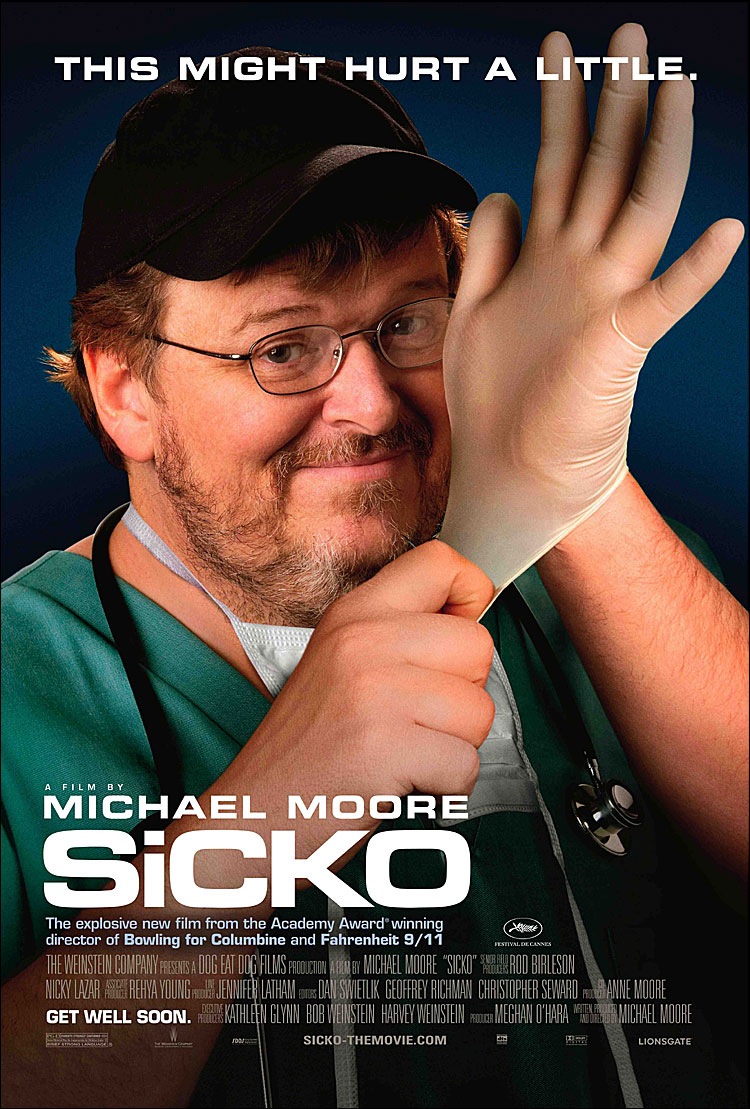
When film director Michael Moore unveiled his new documentary SiCKO - amid a lot of fanfare in earlier this year in Sacramento - some said:
"There he goes again".

Taking in a documentary is one of my favorite past-times.

Of course, the "doc" comes in all varieties. A director may focus on thought-provoking pieces about nature's astounding wonders, or take an insightful foray into an important social or political issue of the day, you name it.

In my mind's eye, when it comes to the latter, the facts should be presented fairly so that the viewer may weigh all the information - and henceforth - arrive at an intelligent reasoned decision about the issues.

For the most part, documentary filmmakers are inspired to "log" a topic because they are all fired up about a project. I mean, somethin' must have got 'em all hopped up to tackle the issues, eh?

For this reason I am inclined to believe that the creators may have a tendency to lean a little.

Undoubtedly, a subtle manipulation of the content is capable of swaying an audience in a particular way.

For instance, whether an insightful (or inflammatory) interview or news clip is placed at the beginning or end of the reel may have a dramatic impact on the viewer.

Although 60 minutes promises to follow the strict dictates of professional journalism - on occasion you can tell by the way the piece was constructed - where their loyalty falls.

One critic spouted recently that documentaries reminded him of "homework".

Joe Queenan - at the LA TIMES - recalled the empty experience of being locked in a steamy smelly auditorium forced to watch grainy films about boring topics produced by the Department of Agriculture.

"I'd rather watch the worst Keanu Reeves movie, I would rather sit through eleven consecutive Demi Moore films (are there that many?) than sit through a documentary," he noted with distaste.

Or maybe he was responding tongue-in-cheek?

No matter.

His statements caused a firestorm from the documentary camp from those who assert that this forum is where political causes, life's injustices and social ills may be brought to the fore.

June Macquire of Mission Viejo quoted Thomas Jefferson:

"If a Nation expects to be ignorant and free, in a state of civilization, it expects what never was and never will be".

Recently, I caught a couple of compelling informative documentaries.

The "Orange Chronicles", for instance.

THE ORANGE CHRONICLES is an examination of Ukraine's Orange Revolution from the perspective of an intrepid Ukrainian-American filmmaker who criss-crossed the country in the weeks before the remarkable events of 2004 as a volunteer Election Observer. The director chronicled what turned out to be a most astonishing bloodless political turnaround.


Another searing insightful documentary on "Darfur" was hosted by award-winning actress - Alfre Woodward - recently at the Fine Arts Theater.


Shortly after the screening about the "alleged genocide" in Darfur, a number of the dailies wrote bold features urging that concerned individuals take action to ensure the atrocities cease.

It helps to have an intelligent articulate public figure involved with a cause to ensure a spotlight will be thrown on the subject.

In recent months, fans of documentaries have demonstrated their loyalty by attending recent screenings at local and national theatres.

For example, the New Beverly Cinema screened a handful of rarely-seen films by one of America's greatest living directors, Martin Scorsese.

In ITALIANAMERICAN (1974, 48 minutes, color) Scorsese focused on the home of his late parents Catherin and Charles (who have appeared in Goodfellas, Mean Streets and Raging Bull). The couple discussed everything from their immigrant heritage to on-camera behavior and the family's secret spaghetti sauce recipe.

In another precious gem Scorsese introduces a main character to the tune of Bunny Berigan's - "I Can't Get Started" - and a shave turns into a musical bloodletting in THE BIG SHAVE (1968, 6 minutes, color). In essence, it's an early black comedy gem that has remained in dusty film vaults unscreened for years.

The American Film Institute got in on the screening trend this year, too, when they presented a few intelligent thought-provoking documentaries in their forum on the genre.

In the future, keep your eye out for them. They're worth catching the second time around.

LYNCH

A rare look into the psyche of the man who created Blue Velvet and ERASERHEAD, LYNCH documents the making of INLAND EMPIRE.

LYNCH talks about the beauty of discovering ideas and the struggle to unveil his cinematic vision. In this film, he is infectious and inspiring.

Hollywood Chinese

Arthur Dong critically re-examines the history of Hollywood's creation of the stereotypic Chinese identity on film. He artfully weaves together 75 years of film clips with insightful commentaries by Ang Lee, Joan Chen, James Hong - and others - who are reshaping the image of Chinese People in the cinema today.

Spine Tingler! The William Castle Story

This documentary chronicles the last great American showman, William Castle.

A master of ballyhoo - who became a brand name in movie horror with his outrageous audience participation gimmicks - Castle treated delighted moviegoers to buzzing seats, flying skeletons, luminescent ghosts and life insurance policies against "death by fright". Director Jeffrey Schwarz artfully unfolds Castle's rags-to-riches role with brio and a wealth of archival footage along with numerous interviews with the impresario's friends, family, and fans.

The Man in the Shadows: Val Lewton

Between 1942 and 1951, Val Lewton stretched his modest $125K budgets into a series of classic genre films.

Martin Scorsese and Kent James celebrate Lewton and his key team (director Jacques Tourneur, editor/director Mark Robson and writer DeWitt Bodeen) and their films which included Cat People, The Seventh Victim, and the Ghost Ship.

Blog Archive